
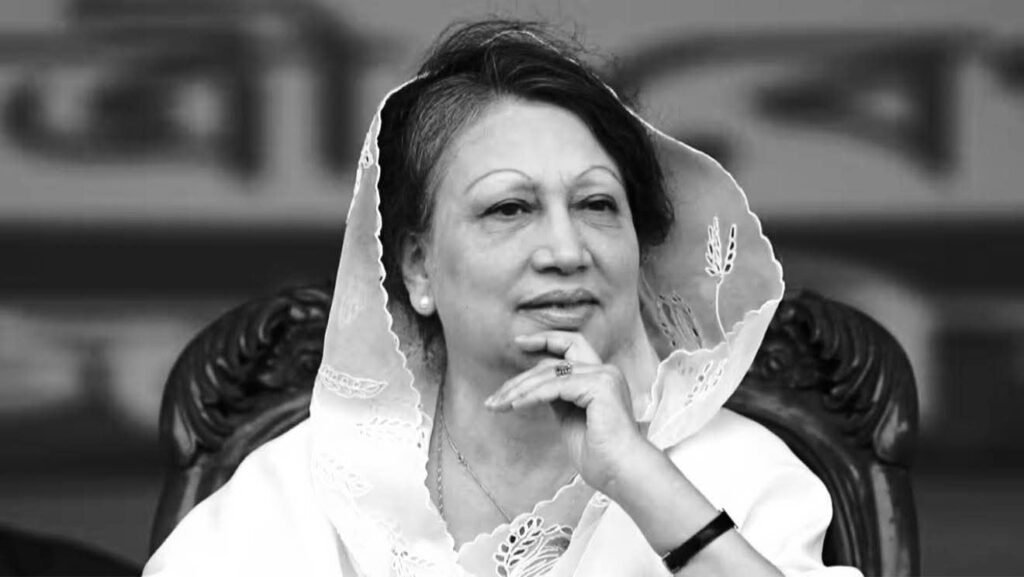
A symbol of unity has passed away.
Begum Khaleda Zia, the symbol of democracy and sovereignty of Bangladesh, a legendary politician and uncompromising national leader, has left everything in worldly life and responded to the call of the great creator. After a long illness, she breathed her last at 6 am on Tuesday while undergoing treatment at Evercare Hospital in Bashundhara, the capital (Inna lillahi wa inna ilaihi raji’un). She was 79 years old. The death of Begum Khaleda Zia marked the end of a chapter in the political history of Bangladesh.
At a press conference at Evercare Hospital at 8 am yesterday, Professor Dr. Shahab Uddin Talukder, head of the medical board formed to treat the BNP Chairperson, announced the death of Begum Khaleda. Today, after Zohr (at 2 pm), Begum Khaleda Zia’s funeral will be held at the historic Manik Mia Avenue in front of the Jatiya Sangsad Bhaban. Special arrangements have been made for women at the funeral. After the funeral, she will be buried at 3:30 pm next to the grave of martyred President Ziaur Rahman, the proclaimer of independence, who lies in the capital’s Zia Udyan. National and world leaders including President Md. Shahabuddin and Chief Advisor Professor Dr. Muhammad Yunus have expressed deep shock and sorrow over the death of the former Prime Minister. In a condolence message, Dr. Yunus said that Begum Khaleda Zia will remain indelible in the hearts of the people of the country. Meanwhile, additional metro rail will run to facilitate participation in the funeral. The interim government in Bangladesh has declared a one-day general holiday and a three-day state mourning program in the wake of the death of this great woman. This decision was made at the meeting of the Advisory Council held at the State Guest House Jamuna at 10:30 am. At the special invitation of the Chief Advisor, BNP Secretary General Mirza Fakhrul Islam Alamgir participated in the meeting of the Advisory Council. The meeting decided on the funeral, burial and other activities of the former Prime Minister with full state dignity. The whole of Bangladesh is mourning the demise of this brave and brilliant great woman. She was a symbol of resistance, courage and unity. Begum Khaleda Zia’s death is like the end of an unforgettable epic. She gave her entire life, took nothing. She fought for the country, the nation and democracy. Through this sacrifice, she became a symbol of national unity. She was elected by the people and served as the Prime Minister of the country three times. 10,000 members of the law enforcement agencies will work to provide security for the funeral and burial of Begum Khaleda Zia. Along with this, members of the army will also be on the ground. Today, tributes will be paid to the BNP Chairperson on both sides of the entire road as her body is taken from Evercare Hospital to the Parliament House.
A condolence and visitation book has been opened at Khaleda Zia’s Gulshan office following her death. Diplomats from 28 countries, several advisors, leaders of various political parties and prominent figures have signed it as of yesterday.
The wife of former President of Bangladesh Shaheed Ziaur Rahman and a popular leader among female prime ministers at home and abroad as well as in South Asia, she was active in politics for more than four decades. Khaleda Zia was accompanied by her eldest son, BNP Acting Chairman Tarique Rahman, who returned to the country after 17 years of exile, daughter-in-law Dr. Zubaida Rahman, granddaughter Barrister Zaima Rahman, younger son Arafat Rahman Koko’s wife Syeda Shamila Rahman, younger brother Shamim Eskander, family members, party leaders and well-wishers. Yesterday, at a press conference, BNP announced a seven-day mourning program. During these seven days, black flags will be flown at the party office, the party flag will be lowered to half-mast, and leaders and workers will wear black badges. BNP Secretary General Mirza Fakhrul Islam Alamgir, National Standing Committee member Mirza Abbas, Senior Joint Secretary General Ruhul Kabir Rizvi and other party leaders were present.
This farewell of Begum Khaleda Zia is not just that of a political leader, she was the courage of a generation. It is the farewell of a guardian who held the entire nation like a mother. She gave courage to the oppressed, gave hope to the hopeless, and showed the path forward to the disappointed people. She was the symbol of a nation’s confidence and struggle. Even in the face of torture, imprisonment, and hundreds of conspiracies both domestic and foreign, she remained uncompromising on the issue of democracy and the rights of the people throughout her life. She never bowed her head against injustice and injustice, never compromised. Rather, she stood by the country and the people with a strong morale. There was firmness in her voice, unwavering faith in her mind, and Bangladesh and its people were in every beat of her heart.
In recognition of her steadfast attitude towards democracy and her long struggle, the international community has awarded her with various awards including ‘Mother of Democracy’ and ‘Fighter of Democracy’. BNP Chairperson Begum Khaleda Zia was awarded the Mother of Democracy Award by the Canadian Human Rights International Organization (CHRIO) on July 31, 2018, for her outstanding contribution to the establishment of democracy. At that time, she was quarantined in an abandoned prison on Nazimuddin Road in Old Dhaka due to a false case filed by the fascist Hasina government. The autocratic Awami League government had also taken away her basic right to medical treatment. It was in this situation that the Canadian organization presented the Mother of Democracy Award to the national leader. Almost three and a half years later, on February 8, 2022, BNP Secretary General Mirza Fakhrul Islam Alamgir presented the crest and certificate given by this Canadian institution to journalists at a press conference. The death of Khaleda Zia has cast a shadow of deep sorrow among people from all walks of life and expatriate Bangladeshis across the country, including the country’s political arena. Mournful leaders and activists have gathered in front of Evercare Hospital in the capital’s Bashundhara residential area, the chairperson’s Gulshan house and political office, and the party’s central office in Nayapaltan area. Her supporters, fans, followers and ordinary people broke down in tears.
Several meetings have been held at the residence of the Chief Advisor, the Ministry of Home Affairs and the National Assembly building to ensure smooth conduct of Begum Khaleda Zia’s funeral and burial. As per the instructions of the Chief Advisor, all preparations have been completed smoothly. All measures have been taken so that people from all walks of life of the country can participate in the funeral of this national leader without any hindrance.
The route from Evercare to the Parliament building area: The body of the deceased will be taken from Evercare Hospital in Bashundhara to the western end of Manik Mia Avenue this morning. The route is – Evercare Hospital – 36 July Expressway – Kuril Flyover – Naval Headquarters – Basbhaban Firoza – Gulshan-2 – Kamal Ataturk Avenue – Airport Road – Mahakhali Flyover – Jahangir Gate – Vijay Sarani – Aeroplane Crossing – Turn right and take the coffin of the leader to the western end of Manik Mia Avenue through Gate No. 6 of the National Parliament Building. Traffic will be controlled on the relevant roads during the journey of the convoy carrying her body. The police administration seeks the cooperation of the public in this regard.
Fighter for Democracy: In recognition of her long and strong role in the establishment of democracy and political struggle, Begum Khaleda Zia received several awards in the international arena. Among them, on May 24, 2011, the New Jersey State Senate of the United States awarded her the Fighter for Democracy Award. It was reported that this was the first time that such an honor was given to a foreign political leader by the US State Senate. This honor was given in recognition of her impeccable role in the movement for democracy, constitutional rule and anti-dictatorship. These international recognitions were a reflection of Begum Khaleda Zia’s role and contribution in the restoration of democracy, protection of voting rights and anti-dictatorship movement during her long political life.
Brief Biography: Bangladesh Nationalist Party (BNP) Chairperson and three-time Prime Minister Khaleda Zia was born on August 15, 1946, in Jalpaiguri, undivided India. She served as Prime Minister for three terms, from 1991 to 1996, for a couple of months in 1996, and for 10 years from 2001 to 2006. She is the first female Prime Minister of Bangladesh and the second female Prime Minister of the Muslim world. She became Prime Minister for a short time in the government formed through the elections on February 15, 1996, to resolve the country’s political crisis and protect democracy. She was elected to the National Assembly on February 15, 1996 to pass a bill for a non-partisan, impartial caretaker government to resolve the country’s political crisis and protect democracy.
Khaleda Zia’s family: Begum Khaleda Zia’s real name is Khaleda Khanam, nickname is Putul. She is the third of three sisters and two brothers. The brothers are the youngest. Her paternal grandfather is Haji Salamat Ali, maternal grandfather is Toabur Rahman of Jalpaiguri. Father is Eskander Majumder and mother is Begum Taiba Majumder. Khaleda Zia’s husband Shaheed Ziaur Rahman is the great freedom fighter, the commander of the first brigade Z Force in the Liberation War and led the battlefield as a sector commander. He was the former army chief of Bangladesh, a former visionary statesman. Of her two sons, the elder son Tarique Rahman (born: 20 November 1967) is the current acting chairman of the Bangladesh Nationalist Party BNP. The younger son is Arafat Rahman Koko (born: 12 August 1970). Arafat Rahman Koko died of cardiac arrest at the University Malaya Hospital in Malaysia on January 24, 2015. Apart from being a businessman, Arafat Rahman was also associated with the Bangladesh Cricket Board and City Club.
Khaleda Zia’s permanent residence: Khaleda Zia’s house is in Mudipara, Dinajpur city. Her ancestral home is Majumdar’s house in Sreepur village, Fulgazi upazila, Feni district. Her father, Eskandar Majumdar, was a businessman. Eskandar Majumdar went to Jalpaiguri from Feni in 1919. He passed his matriculation from his sister’s house and later got involved in the tea business. He lived in the Nayabasti area of Jalpaiguri until 1947. He passed away on November 15, 1984. His mother, Begum Taiba Majumdar, was a housewife.
Khaleda Zia’s Marriage: She married Captain Ziaur Rahman in August 1960. Ziaur Rahman’s nickname was Kamal. Zia was then a captain in the Pakistan Army. He was working in Dinajpur as an officer of the DFI.
Family life: In 1965, Khaleda Zia went to West Pakistan (now Pakistan) with her husband. She stayed with her husband in Karachi until March 1969. Then she moved to Dhaka. After staying in Joydevpur for a while, she lived with her husband when he was posted in Chittagong and in Sholashar Ekala in Chittagong. After hiding for a while at the beginning of the Liberation War, Khaleda Zia moved to Dhaka by boat on May 16. She stayed at her elder sister Khurshid Jahan’s house until June 17. On July 2, Pakistani soldiers captured her along with her two sons from S Abdullah’s house in Siddheshari. She was imprisoned in Dhaka Cantonment until December 15, 1971. She was released when Bangladesh became independent on December 16. Begum Zia was an ordinary housewife until she entered politics. Even when Ziaur Rahman was the President of Bangladesh, Begum Zia had no presence in politics.
Begum Zia in Politics: On May 30, 1981, Ziaur Rahman was killed in a failed military uprising by some ambitious army personnel. Then, at the urging of leaders and activists from various levels of BNP, she joined the BNP on January 3, 1982. On March 24, 1982, the then Army Chief Lieutenant General Ershad ousted Justice Abdus Sattar. Begum Zia opposed this. In March 1983, she became the Senior Vice Chairman of the BNP. She gave her first speech at the extended meeting of the party on April 1, 1983. When Justice Sattar fell ill, she served as the acting chairperson of the party. On May 10, 1984, she was elected unopposed as the chairperson of the party. BNP fully developed under her leadership.
Movement-Struggle: In 1983, a seven-party alliance was formed under the leadership of Begum Zia. At the same time, a movement against Ershad’s military rule began. Begum Zia first started an anti-Ershad movement through the seven-party alliance with BNP from September 1983. At the same time, 7 parties under her leadership jointly started a movement program with 15 parties led by the Awami League. The five-point movement continued until 1986. But on the night of March 21, 1986, when Awami League President Sheikh Hasina decided to participate in the elections under Ershad, obstacles arose in the united movement. The 15 parties were divided into 8 parties and 5 parties. The 8 parties went to the elections. Then, under the leadership of Begum Zia, the 7 parties and the five-party alliance launched a movement and he rejected the elections. From 1987, Khaleda Zia started a one-point movement called ‘Ershad Hatao’. As a result, Ershad dissolved the National Parliament. The united movement resumed. After the fall of Ershad, BNP achieved a single majority in the National Parliament elections held on February 27, 1991. Khaleda Zia was elected Prime Minister of Bangladesh. In that election, Khaleda Zia contested a total of five seats and won all of them.
On March 19, 1991, Begum Khaleda Zia was appointed as the Prime Minister of the People’s Republic of Bangladesh. Her government replaced the presidential system with a parliamentary system of government in the country. The sixth national parliamentary election was held on February 15, 1996. Khaleda Zia and her party won a single election. This parliament lasted only 15 days. Khaleda Zia was elected Prime Minister. The caretaker government bill was passed in this parliament and Khaleda Zia later resigned. She organized this election mainly to get the non-partisan, neutral caretaker government bill passed in the national parliament to save the country from the then-existing democracy and political crisis.
In the seventh parliamentary election on 12 June 1996, BNP won a total of 116 seats. In that parliament, BNP emerged as the largest opposition party in the history of Bangladesh. She was the opposition leader at the time. In the parliamentary election on 1 October 2001, a four-party alliance led by BNP won by a landslide and formed the government. Khaleda Zia served as the Prime Minister in this parliament as well. The term of this parliament ended on 28 October 2006.
Arrest and Jail: On July 2, 1971, Begum Khaleda Zia was arrested by the Pakistani army along with her two young sons from a relative’s house in Dhaka and put in jail. She was arrested a total of six times since joining the party as a primary member of the BNP on January 3, 1982. During the anti-Ershad movement, she was arrested on November 28, 1983, May 3, 1984, and November 11, 1987. She was arrested with her son on September 3, 2007. She was released on September 11, 2008 on the orders of the High Court. After being arrested by the caretaker government, she spent a long year and seven days in jail. The voterless occupying Awami League government sentenced her to 10 years in a formal verdict on February 8, 2018 in a case filed by the ACC for political vendetta. She then spent about two and a half years in the abandoned Dhaka Central Jail on Nazimuddin Road. After the escape of the fascist Hasina, she was released on August 6, 2024 by the President’s executive order.
Eviction from the cantonment house: On November 13, 2010, Begum Zia was forcibly forced to leave her 40-year residence. Law enforcement officers loyal to the fascist Hasina government dragged her out of her house. After independence, Khaleda Zia, who was the Adjutant General of Ziaur Rahman, moved into house number 6 on Shaheed Mainul Road with her. On May 30, 1981, when President Zia was killed in a failed military coup in Chittagong, the then interim President Abdus Sattar allotted the house in the cantonment in Khaleda Zia’s name on June 12. Fascist Hasina evicted her from that house. Tarique Rahman, son of Begum Khaleda Zia, was devastated by the death of Begum Khaleda Zia. Eight hours after her mother’s death, he wrote to the nation about his emotions, feelings and inner thoughts about his mother. He sought prayers from the countrymen for the forgiveness of the soul of his loving mother, Begum Khaleda Zia.